Choose the hose from the pressure, airflow, temperature, movement, and surrounding hazards at its actual point of use—not from the compressor outlet size or a familiar nominal diameter. By the end, you will have a practical specification for the hose, couplings, fittings, routing, and acceptance checks before installation.
Key takeaways
- Rate the hose above maximum site pressure, including spikes and failed-regulator pressure.
- Size the bore for airflow, hose length, and pressure loss through fittings.
- Match hose construction to air quality, temperature, abrasion, oil, and workplace conditions.
- Inspect the complete assembly, including couplings, clamps, threads, and identification markings.
Start with the pressure and temperature at the hose location
Choose the air hose working pressure from the highest pressure possible at the hose location, not the normal gauge reading. Include the compressor cut-out pressure, the regulator setting, a failed regulator, pressure spikes and pulsation conditions.
Select a hose whose maximum working pressure exceeds that worst-case pressure and remains valid at the actual temperature; do not treat burst pressure as an operating limit.
Temperature means more than the workshop air. Check compressed-air temperature after the compressor and cooling equipment, ambient temperature, and any radiant or contact heat from pipes, engines, furnaces, or machinery. Elevated temperature can reduce the permitted pressure below the room-temperature rating.
| Figure | What it means | How to use it |
|---|---|---|
| Maximum working pressure | Continuous pressure permitted at a stated temperature | Use this figure for selection and verify it exceeds the worst case |
| Maximum allowable pressure | The equipment or assembly limit identified by the manufacturer | Do not exceed the lowest limit in the connected system |
| Test pressure | Proof pressure used during testing | Do not use it as a running-pressure rating |
| Burst pressure | Pressure at which a test hose fails | Never use it to justify operation |
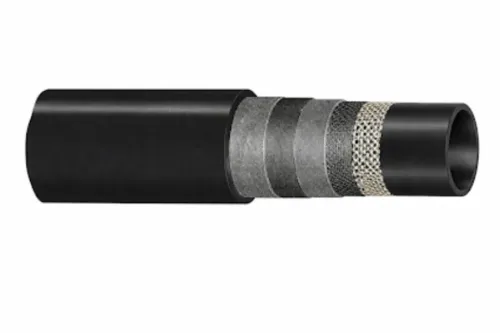
Ask for the hose type, reinforcement construction, nominal working pressure, temperature range, and applicable standard, such as ISO 2398 for textile-reinforced rubber compressed-air hose. A high pressure rating does not permit unrestricted cleaning: OSHA limits compressed air at the nozzle to less than 30 psi with chip guarding and PPE.
Fit whip checks, retaining clips, or equivalent restraints at exposed connections.
Size the bore for airflow, hose length, and fittings
A tool can reach its rated pressure and still lose speed under load if the hose bore or quick-connect passage cannot deliver enough air. Size the entire path from compressor outlet to tool inlet, not the hose by its nominal label or the compressor outlet size.
Base the pressure-drop calculation on four inputs:
- The hose’s actual air hose inside diameter, not the printed nominal size
- The total hose length, including extensions
- The tool’s air demand in CFM and litres per minute at the stated reference condition
- Pressure loss through couplings, swivels, adapters, and fittings
Set the allowable pressure drop before choosing components. Then compare the manufacturer’s flow tables at your operating pressure. A “1/2-inch” hose with a narrow bore or restrictive coupling can deliver less air than another hose carrying the same nominal size.
| Size | Practical starting point | Check before use |
|---|---|---|
| 1/4-inch hose | Short runs and low-consumption tools | Confirm flow under load |
| 3/8-inch hose | General pneumatic tools and moderate runs | Check coupling passage and length |
| 1/2-inch hose | High-demand tools or long runs | Verify the tool’s required CFM and fitting size |
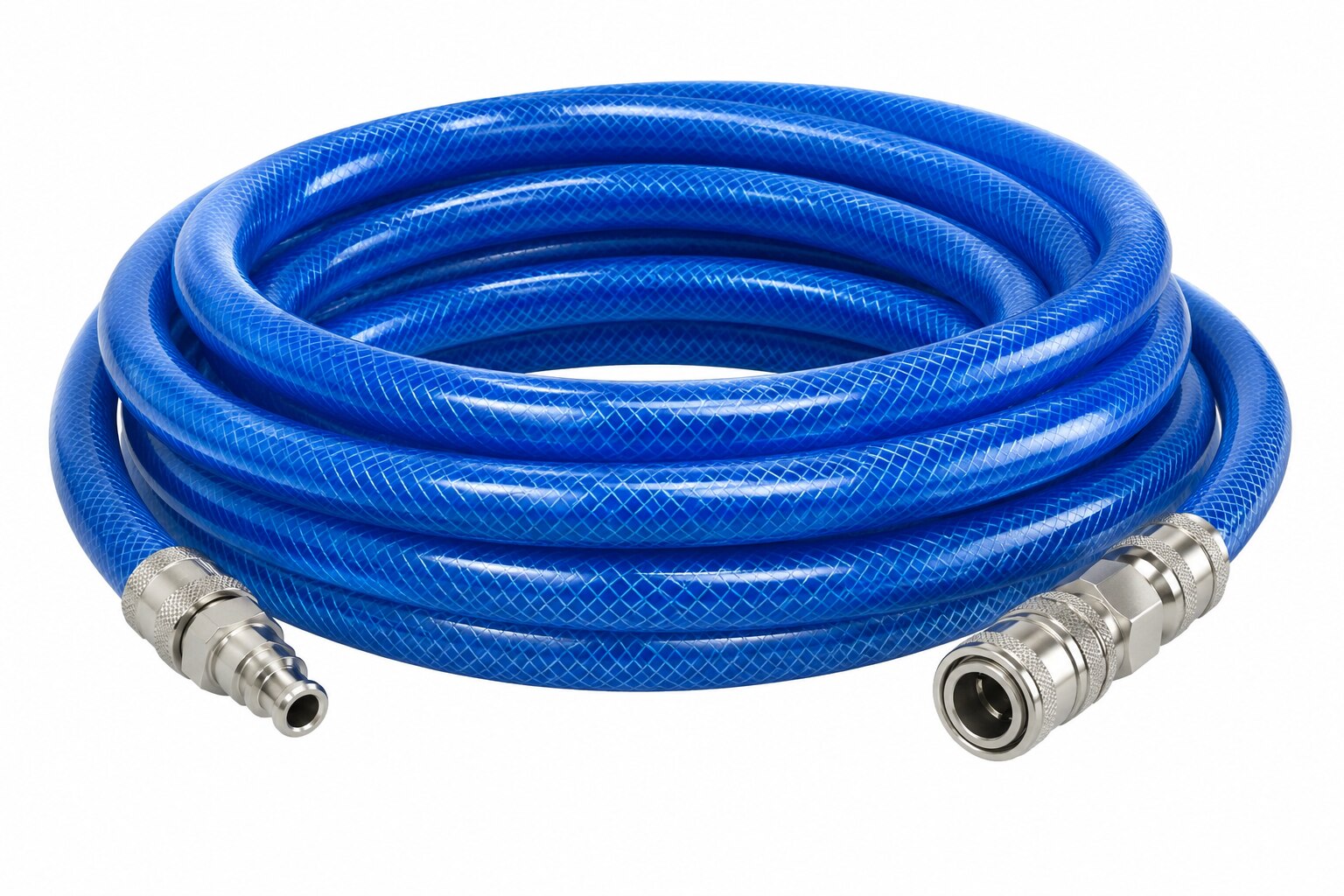
Choose couplings with a full-flow passage and a compatible profile; a pressure rating does not prove adequate airflow. At exposed tool and manifold connections, fit a whip check, retaining clip, or equivalent restraint so a failed connection cannot turn the assembly into a whipping hazard.
Match the hose construction to air quality and the work environment
Temperature can disqualify an otherwise correctly rated hose. Record compressed-air temperature after the compressor’s cooler and dryer, the lowest and highest ambient temperatures, and any radiant or contact heat. Compare that total with the manufacturer’s compressed-air temperature range; elevated temperature can require pressure derating even below the room-temperature rating.
The rubber versus PVC polyurethane hybrid air hose choice depends on exposure and movement:
| Option | Oil and chemical behaviour | Suitable use |
|---|---|---|
| Rubber with EPDM tube | EPDM hose oil mist resistance is limited; verify compatibility with compressor lubricant and condensate | Hot air or outdoor service when oil exposure is controlled |
| Rubber with NBR oil-resistant tube | NBR oil-resistant tube handles many petroleum-based oils better; confirm synthetic oil and additive compatibility | Lubricated compressors and oil-laden air |
| PVC or polyurethane | Light, flexible and abrasion-resistant, but temperature, solvent and kink limits vary by formulation | Clean, cooler air and portable tools |
| Hybrid construction | Combines a rubber-like cover with a plastic inner tube; check each layer separately | Installations needing flexibility and controlled oil exposure |
“Oil resistant” can describe the tube, cover, or both. Check external exposure to fuel, solvent and cleaning chemicals rather than relying on the label.
For static discharge, specify conductive, antistatic or electrically non-conductive construction and verify the finished assembly’s resistance classification. A black hose proves nothing, and a conductive hose alone does not make a hazardous-area installation compliant. For robotic movement or frequent coiling, select the manufacturer’s dynamic-service range and confirm its flex-cycle, bend-radius and torsion limits.
Choose length, flexibility, and routing for the way the hose moves
Choose an air hose length that reaches the tool without a loose loop. Excess length increases pressure loss, snagging, and wear; too little length pulls on couplings and encourages sharp bends. Measure the actual route, then include only enough slack for the operator’s movement.
Keep every bend above the hose’s minimum bend radius, including the area beside each fitting. Bending below that limit can buckle the bore and damage reinforcement before the cover looks worn. Bend restrictors and swivel fittings reduce bending at connections, but they do not permit tighter routing than the manufacturer allows.
| Routing choice | Main risk | Better control |
|---|---|---|
| Fixed machine connection | Abrasion and fitting stress | Clamp the hose, support its weight, and protect contact points |
| Frequently moved pneumatic tool | Kinks, torsion, and fatigue | Use a dynamic-service hose with a stated flex-cycle capability and torsion limit |
| Hose crossing a walkway | Trips and crushing | Reroute overhead or along a protected edge; never leave a slack loop |
| Exposed tool or manifold connection | Hose whip after coupling failure | Fit retaining clips, whip checks, or an equivalent restraint |
Select a dynamic-service hose for repeated coiling, robotic movement, or constant flexing; a fixed-installation hose is not automatically suitable. Route the hose so the tool pulls along its axis, not sideways, and inspect for flattened sections, cuts, and exposed reinforcement.
For pneumatic tools, secure connections against whipping. A coupling’s pressure rating alone does not control hose whip.
Specify and inspect the complete hose assembly before connection
Request an assembled, traceable product—not a length of “air hose.” Give Kanta Enterprises or another supplier the operating pressure, temperature, hose length, end fittings, coupler profile, and tool connection details, then require documentation for the finished assembly.
1. Ask for the hose marking or datasheet identifying it as an ISO 2398 air hose, its hose type, reinforcement, nominal working pressure, temperature range, and batch or serial number. Confirm that the maximum working pressure covers compressor cut-out pressure, regulator failure, surges, and pulsation at the actual temperature.
2. Check working pressure versus burst pressure. Burst pressure describes failure, not permitted operation; accept the assembly only when the working-pressure figure is clearly stated for the complete assembly and fittings, ferrules, swivels, adapters, and clamps meet or exceed it.
3. Confirm the manufacturer’s specified crimp or fitting system. Reject improvised barbs, ordinary clamps, mismatched threads, or couplers that do not lock and seal with your tool and manifold.
4. Require the supplier’s inspection or test record and the ISO 1402 hydrostatic test result for a new or re-terminated assembly. Do not substitute an improvised pneumatic pressure test: compressed air stores far more hazardous energy.
5. Inspect the cover for cuts, bulges, exposed reinforcement, crushed sections, and unreadable markings. Verify quick coupler compatibility and whip checks, retaining clips, or equivalent restraints at exposed connections before pressurising; a pressure-rated coupling alone will not prevent hose whip.
Related product
 | RUBBER SANDBLAST HOSE Tube: Abrasion resistant, anti-static modified natural & synthetic rubber blend. View product → |
Frequently asked questions
How do you determine an air hose pressure rating?
Use the highest pressure possible at the hose location, including compressor cut-out pressure, regulator failure, pressure spikes, and pulsation.
How does hose bore size affect compressed-air delivery?
Select the bore based on required airflow, hose length, and restriction from fittings; an undersized bore increases pressure loss.
What air hose construction suits a particular work environment?
Match the tube, reinforcement, and cover to air quality, temperature, oil exposure, abrasion, chemicals, and other site hazards.
How should you choose an air hose length and routing?
Choose enough length for the tool’s full movement, then route it to avoid sharp bends, kinks, dragging, crushing, and unnecessary loops.
What should you inspect before connecting an air hose assembly?
Check the hose rating and markings, fittings, couplings, threads, clamps, seals, and visible damage across the complete assembly.